
Employee Monitoring Software Pricing in India: What Should Businesses Compare?
· 5 min read
- Pricing
- Employee Monitoring
- Software Comparison
- GST
- SaaS
- Buying Guide
- India
- Small Business
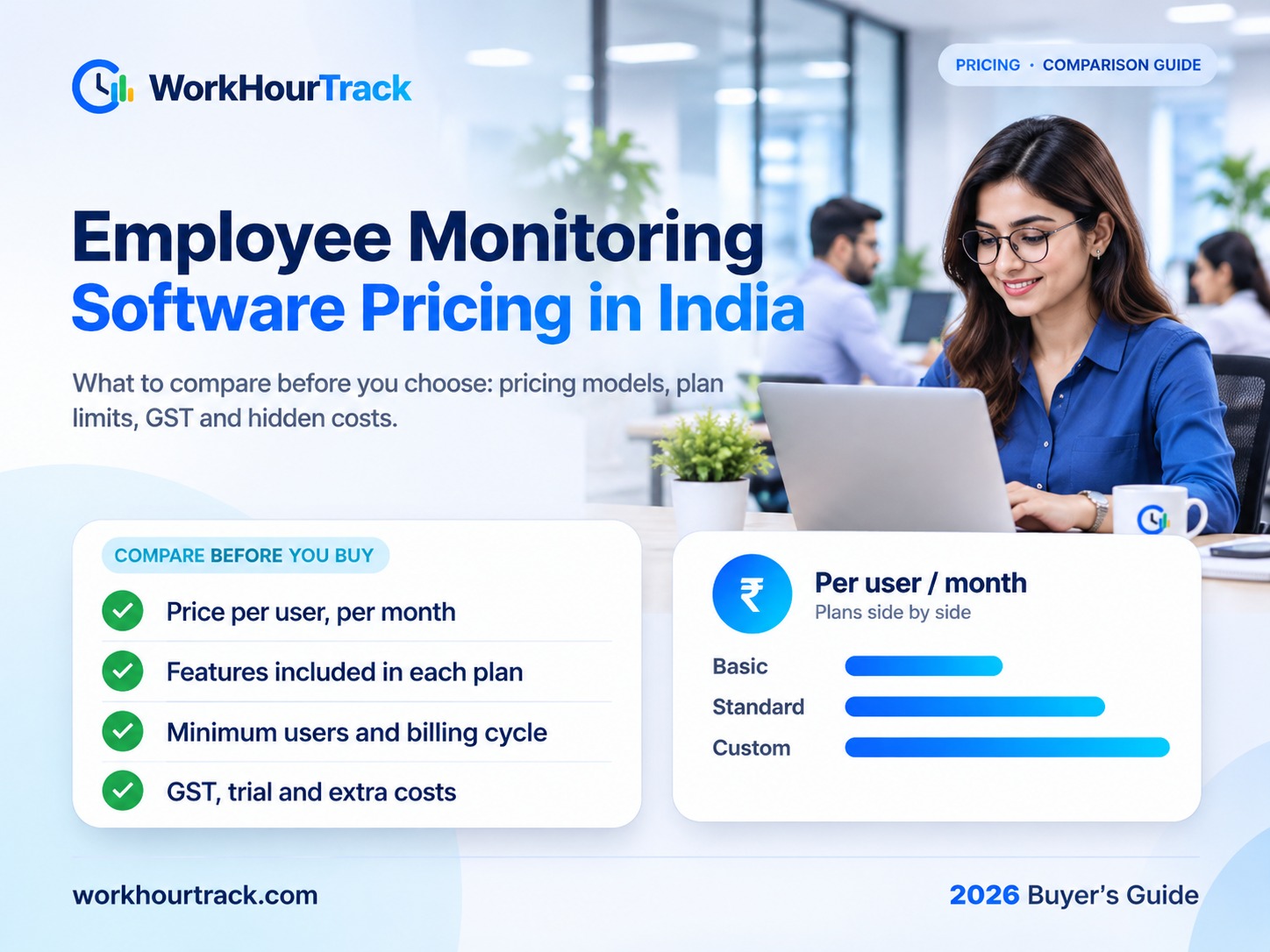
Employee monitoring software pricing in India can look simple on a plan page, but the real cost depends on how the tool charges, what each plan includes and what gets added on top. This guide shows what businesses should compare, from price per user and plan limits to GST, trial terms and hidden costs, so you can judge employee monitoring software in India fairly before you buy.
How employee monitoring software is priced
Most tools use one of these models:
- Per user, per month. The most common model. You pay a set amount for every employee you track.
- Tiered plans. Plans such as Basic, Standard and Business unlock more features or allow more users.
- Minimum seats. Some vendors require a minimum number of users before you can buy.
- Flat or custom pricing. Large organisations often get a quote based on users, deployment and support.
- Monthly or annual billing. Annual plans usually cost less per month but need a longer commitment.
What does employee monitoring software cost in India?
There is no single price. Many well-known global tools publish prices in US dollars, and one vendor guide puts typical 2026 prices at roughly $3 to $15 per user per month. Treat that as a rough range, because plans, features and billing periods differ a lot. Even one tool can show two prices: an entry plan may cost less per month when billed annually than when billed monthly.
Always read the price on the vendor's own page, check the billing period, and convert any US dollar price at the current exchange rate. At the time of writing, WorkHourTrack is priced per user per month in rupees: ₹150 for teams of up to 10 users and ₹100 for companies with 11 to 40 users, with custom pricing for larger teams. See the current plans in the pricing section.
Eight things businesses should compare
- Pricing model and minimum users. Is it per user, is there a minimum, and what happens when your team grows?
- What is in each plan. Check screenshots, app and website tracking, project tracking, reports, roles and permissions, and API access. Cheap plans often leave out the features you need.
- Currency and payment. Rupee pricing avoids exchange-rate changes and foreign card fees.
- GST. SaaS is generally charged 18% GST in India. Check whether the quoted price includes or excludes it, and ask your accountant about claiming input tax credit.
- Free trial. Is a card required, how long is it, and does it include all features?
- Contract terms. Look at monthly versus annual billing, cancellation and the refund policy.
- Support and onboarding. Find out whether support is included or only on higher plans.
- Privacy and transparency. Check for an employee notice, a visible app and clear data policies. Read our guide on whether employee monitoring is legal in India, and review the vendor's Privacy Policy and Data Processing Agreement.
Hidden costs to watch for
- Add-ons for screenshots, longer data storage, integrations or API access.
- Minimum seat counts that make a small team pay for users it does not have.
- Setup or training fees.
- Feature upgrades that push you to a higher plan after you sign up.
- Renewal price increases after the first term.
- GST and currency conversion added on top of the quoted price.
How to estimate your yearly cost
Use this simple formula: users × price per user × 12 months, plus GST if the price excludes it.
For example, with 20 users at ₹100 per user per month and a price that excludes GST: 20 × ₹100 × 12 = ₹24,000, plus 18% GST (₹4,320) = ₹28,320 a year. This is only an illustration, so replace the numbers with your own quote.
Match the plan to your team
- Small team (up to about 10 users): choose simple per-user pricing, a free trial and the features you will actually use.
- Growing company (about 11 to 40 users): check for volume pricing, reports and project tracking.
- Large organisation (40+ users): ask about custom pricing, security, dedicated support and deployment options.
How WorkHourTrack pricing works
WorkHourTrack is priced per user per month in rupees, with plans by team size:
- Small Teams: for teams of up to 10 users.
- Companies: for growing companies with 11 to 40 users.
- Enterprises: custom pricing for teams with more than 40 users, including live tracking and dedicated support.
The paid plans include screenshots, app and website tracking, project tracking, advanced reports and priority support, on Windows and Mac computers. You can start with a 3-day free trial, no credit card required. See the full feature list, the pricing section and the homepage FAQ.
Frequently asked questions
How much does employee monitoring software cost in India?
Most tools charge per user per month. Global tools often list prices from about $3 to $15 per user per month, while Indian vendors may price in rupees. Compare features, billing period and GST, not just the headline price.
Is GST charged on employee monitoring software?
Yes. SaaS subscriptions are generally charged 18% GST in India. If your business is GST-registered and uses the software for taxable supplies, you can usually claim the GST as input tax credit, but confirm this with your accountant.
Is there free employee monitoring software?
Some tools offer free plans, but they are usually limited to a few users or basic features. WorkHourTrack offers a 3-day free trial with no credit card required, so you can test the full product first.
Should I choose monthly or annual billing?
Annual billing is often cheaper per month, while monthly billing gives flexibility. Start with a free trial, then choose annual billing once you are sure the tool fits your team.